Get to Know Olga Tokarczuk and ‘Flights’ Through These Six Quotes
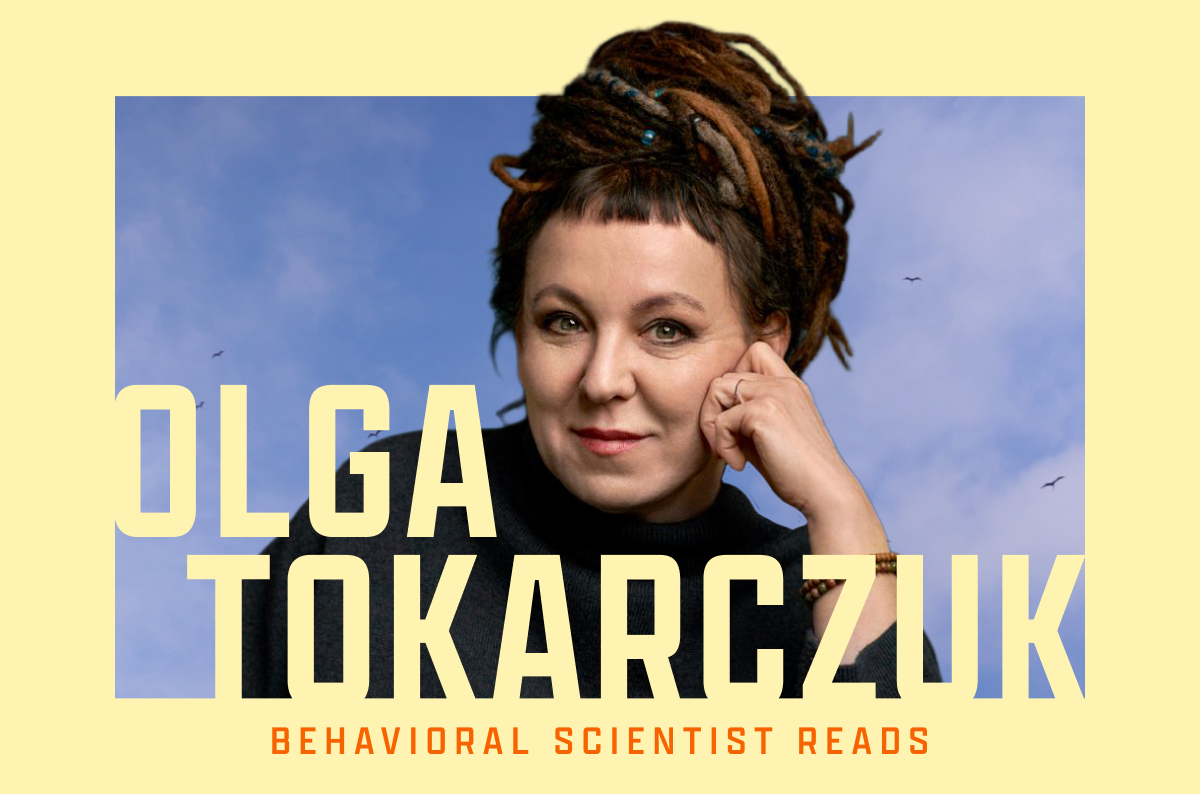
Who is the author we’ll be spending time with this summer, Olga Tokarczuk? And what do we know about this strange, fragmented novel Flights that we’re about to begin?
I’ve selected six quotes from Tokarczuk to help us get to know her and Flights. They span her childhood in Poland, the influence of psychology on her writing, the origins of Flights, and “the most important and the strangest set of words in the world.”
But before we hear from the author in her own words, a brief biography: Olga Tokarczuk (b. 1962) is a Polish writer who is known for her constellation-style novels that bend and challenge traditional methods of story telling. She’s also known for rich and imaginative explorations of Polish history—perhaps best exemplified by her 900-plus page novel, The Books of Jacob.
In her work, despite the new ways she pushes the novel as a form, you’ll find the influence of some of the oldest forms of storytelling, myths and fables. She has also been deeply influenced by the sciences, including psychology, evolution, ecology, and astronomy.
In total, she has written 10 novels, and Flights was her seventh. It was published in Poland in 2007, but it took 10 years for an English translation to come out. Publishers readily acknowledged her originality, but they weren’t sure how readers would respond to her constellation style of storytelling. (i.e. Will people buy something that doesn’t have a cookie-cutter plot?).
For Flights, Tokarczuk won Poland’s top literary prize, the Nike award, and the Man Booker International Prize (along with her translator Jennifer Croft). She’s won a number of other awards as well, most notably, of course, the Nobel Prize in Literature in 2018.
Before becoming a writer, Tokarczuk studied psychology and worked as a clinical psychologist, an experience she credits with helping shape her perspective as a writer.
Now, in her own words…
Growing up and exploring
“I was the first of two children born to a pair of teachers, who as a young married couple full of energy and enthusiasm came to the so-called Recovered Territories (the part of western Poland that before the Second World War belonged to the German Reich, but was assigned to Poland after it under the terms of the treaty signed at Yalta as compensation for the territory it had lost to the east, which is now part of Ukraine). . . .
“From today’s perspective, many people might see the 1960s as ancient history. It really was another world. In Poland there was no public television yet. I remember watching a television programme for the first time at the age of six. So I can say that I belong to a generation of people who were not shaped by television from early childhood. Telephones were rare, and were operated by turning a crank handle. You placed a call to the number you wanted via the exchange, and waited for your connection. There were hardly any private cars, which meant that every single journey, even a trip to the nearest town, was a major expedition. We lived on a rather unvaried diet of locally produced food. I had no idea what a banana tasted like. Lemons were a luxury. . . .
“Before I ever went to school I used to spend a great deal of time on walks, investigating the enormous park, its ponds, paths, hidden nooks and passages; I also used to go to the nearby village to observe the people, their way of life, the objects they had and their animals. I used to head off to the banks of the Oder too; instinctively aware of its power and danger, I always kept my distance from its unpredictable current.
“This childhood vagrancy has stayed with me all my life, and whenever I find myself in a new place, I like to have a reconnoitre, to get to know the short-cuts, the relative location of the buildings and the major landmarks. I also think the best way to explore a city is to set off on an unplanned walk, letting pure whim and fancy be your guide as you wander the streets. As an adult traveller I have spent days at a time touring great cities in this way—London, Moscow and New York—in comfortable shoes and with a thermos in my backpack, walking the length and breadth of the place, and only using the subway as a last resort.”
Source: Nobel autobiographical sketch
On Poland and Central Europe
“I’ve always been aware that as a writer I belong, like it or not, to the great land that is Central Europe (though there are many people who doubt whether such a thing really exists). All I know is that it’s the space between the West and the East, the North and the South. Time flows differently here, not in a linear way, but by turning circles, although nobody ever learns the lessons of history.
“Everything here seems fluid and sketchy—the borders wander, and so do the nations, the language influences shift, and views and ideas mix as in a melting pot. It’s a place where things bud and come into being, but afterwards the seeds always go off into the world and gather strength somewhere else. It’s a crater which pours out lava in the form of wave after wave of migrants who power Western Europe, and above all the New World.
“I’ve always felt myself to be part of this land, and as proof I’m happy to offer the fact that in the course of her life my grandmother, who had the same name as me, had four different passports.”
Source: Nobel autobiographical sketch
The influence of psychology on her writing
“Studying psychology and coming into contact with psychotherapy supplied me with the belief that we live in a world where many points of view co-exist. This sort of relativism shows the world as a complex, multi-layered story that, seen from various viewpoints, seems infinitely rich and is a challenge for our intellect and our psyche.
“If there is such a thing as an initiation into writing, I think that in my case it was to do with a minor, but essential insight—the reality in which we live as biological and psychological creatures can be constantly re-interpreted in new ways.”
Source: Nobel autobiographical sketch
On the origins of Flights
(This transcript has been lightly edited for clarity.)
“The process of writing it was more or less between 2004 and 2006. At the time I had a kind of very special moment in my life, perhaps it's too personal [to go into], I realized that I have to change something.
“This is very obvious when you pass into your forties—the sign of perhaps a crisis or something like that. And I decided that having a passport, which is not so obvious for us from Central Europe, but at that time we had our passports, Poland was a part of the European Union and the borders were open for us, so I decided to just go and travel as far as it is possible.
“And I desperately wanted to write about my traveling, but I desperately was looking for a form—how to put into words my entire experience of traveling. Of course there are classical forms, such as memoirs of travelling, reportage is another classical form. But everything was not suitable for my experience. I thought that traveling is not just traveling on the ground anymore, it is rather jumping from one point to the other. It is like zipping with the [remote] for the television, changing the channel all the time.
“Today in the morning I was in Washington DC, today [in the evening] I am in Boston. So this is a kind of jumping. This book is devoted to this feeling of traveling as a jumping, traveling as very quick changes, and trying to collect all those small detailed experiences into one pattern. So I invented this constellation novel.”
Source: GBH Forum Network
On the role of the reader in Flights
(This transcript has been lightly edited for clarity.)
“My first image was a kind of metaphor when you are standing on the porch during the night, you are looking above, and you can see the sky full of bright points. You can see the stars, and in fact this is a chaotic order. But our brain, our mind, is perceiving this chaotic order in a kind of shape, in a constellation, and behind those constellations, there is an entire tradition of our civilization, of our culture—mythological stories, meanings, senses, and so on.
“So this book was designed as a constellation full of small, bright spots, like small text. And it is dedicated to you, the reader, to do something with your mind with the entire collection of those spots.”
Source: GBH Forum Network
“The most important and the strangest set of words in the world”
“The first photograph I ever experienced consciously is a picture of my mother from before she gave birth to me. . . . Gazing off somewhere outside of the frame, the somewhat hunched-over woman sees something that isn’t available to a person looking at the photo later. As a child, I imagined that what was happening was that she was gazing into time. There’s nothing really happening in the picture—it’s a photograph of a state, not a process. The woman is sad, seemingly lost in thought—seemingly lost.
“When I later asked her about that sadness—which I did on numerous occasions, always prompting the same response—my mother would say that she was sad because I hadn’t been born yet, yet she already missed me.
“‘How can you miss me when I’m not there yet?’ I would ask.
“I knew that you miss someone you’ve lost, that longing is an effect of loss.
“‘But it can also work the other way around’ she answered. ‘Missing a person means they’re there.’
“This brief exchange, someplace in the countryside in western Poland in the late sixties, an exchange between my mother and me, her small child, has always remained in my memory and given me a store of strength that has lasted me my whole life. For it elevated my existence beyond the ordinary materiality of the world, beyond chance, beyond cause and effect and the laws of probability. She placed my existence out of time, in the sweet vicinity of eternity. In my child’s mind, I understood then that there was more to me than I had ever imagined before. And that even if I were to say, ‘I’m lost,’ then I’d still be starting out with the words ‘I am’—the most important and the strangest set of words in the world.”